
Perfect scores on AI agent memory and control benchmarks
AI agents fail in two boring ways. They act on old or wrong information, and they do things nobody allowed. One line hidden in an email can cause both. And when something goes wrong, all you have to show anyone is a log you wrote yourself.
Proofable fixes both and proves it. Each fact your agent loads knows whether it still holds and whose it is. Each action is checked against what you allowed before it runs. And everything it does leaves a signed receipt that you, a client or another agent can check without asking us.
The results, on benchmarks other teams built
-
Top score of 20 teams in NVIDIA's Live Agent Gauntlet, live on stream.
-
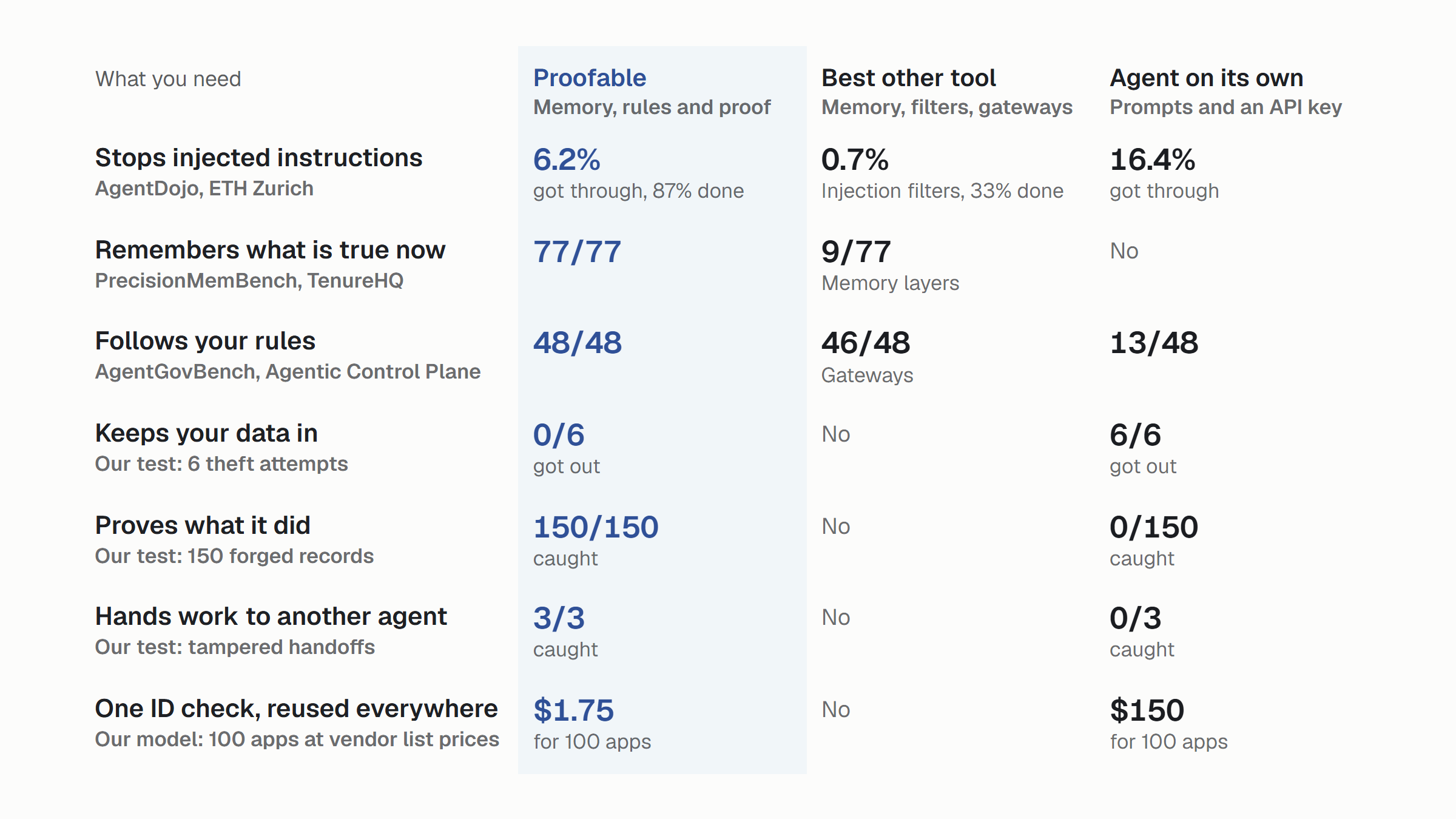
48 of 48 on AgentGovBench, the only one of nine setups to hold every scenario. The maintainers' own gateway holds 46.
-
6.2% of prompt injections landed on ETH Zurich's AgentDojo, vs 16.4% with no defense, with 87% of tasks still done.
-
77 of 77 on Tenure's PrecisionMemBench, tied with the team that wrote it. Mem0, Zep and Cognee score 9.
We ran our own rows. Every other row is that team's published run, and no benchmark author has endorsed our results.
What it saves you
-
11.1x fewer tokens every time your agent looks up the current rule, because it loads only what still holds.
-
3.7 ms and zero tokens to check an agent's finished work, vs 2.79 s and 2,426 tokens to have a model redo it.
-
$1.75 vs $150 to check one person across 100 apps. At Stripe Identity's $1.50 list price, 100 apps each re-running the check pay $150. One check at $1.50, then 100 checks of the proof at $0.0025 each, is $1.75.
Those savings land on whoever runs the agent, the day it runs. Nobody else has to adopt anything first.
How it works
Every check Proofable runs becomes a portable proof, a signed record of what was checked, whose it is and whether it still holds. Your agent's permission is one. Each receipt is one. Each fact in its memory is one.
That is why one design moves all four results. A tool call that needs a permission the agent doesn't hold is refused before it runs. A replaced or foreign fact is dropped before memory ranks anything. And a receipt is checked on the reader's own machine in milliseconds, so a client, an auditor or the next agent doesn't take your word for it, or ours.
import { verifyPortableProofEnvelope } from '@proofable/sdk';

// Runs anywhere. No account, no call to us.
const { valid } = await verifyPortableProofEnvelope(envelope);
The record format is CAIP-380, an open draft standard we wrote. Proofable has run in production since mid-2025, passed an independent security audit with no findings from critical to low, and runs 14 checks today, from proof of human with ZKPassport and wallet risk with Webacy to domains, work accounts and AI agents.
If agents come to you, the same record works from the other side. Check an agent's owner and permission before it acts, and refuse what you can't check.
48 of 48 on agent rules
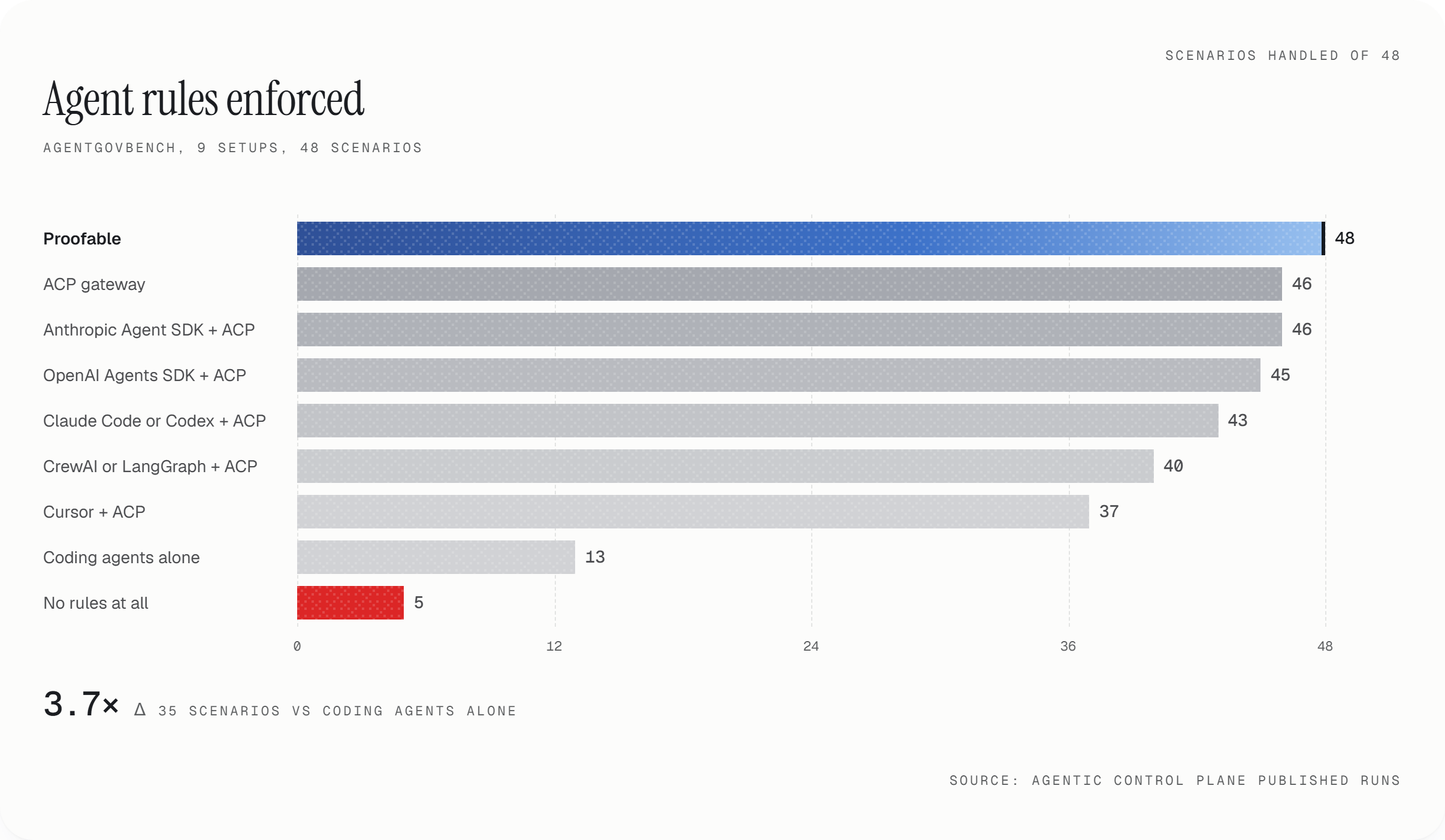
AgentGovBench is 48 open scenarios: audit trails, keeping customers apart, who authorized whom, failure modes, identity, per-user rules, rate limits, and sub-agents that should get less access than their parent.
You set each agent's rules once. They name its tools, a spend cap, an end date and the actions that wait for your yes. Every tool call is checked before it runs. A running job keeps re-checking and stops if it can't confirm its rules for 60 seconds.
A gateway sees each request on its own. It can't hold the rules you set for that exact agent, and it can't hand an outsider a record to check.
Our row is the rules engine the live service runs, pinned by hash, on the maintainers' current scenario set. Their gateway's 46 is their own run on that set. The agent-tool rows are their April runs on the previous version, which they flag for a re-measure, so treat those as indicative.
Prompt injections cut by more than half
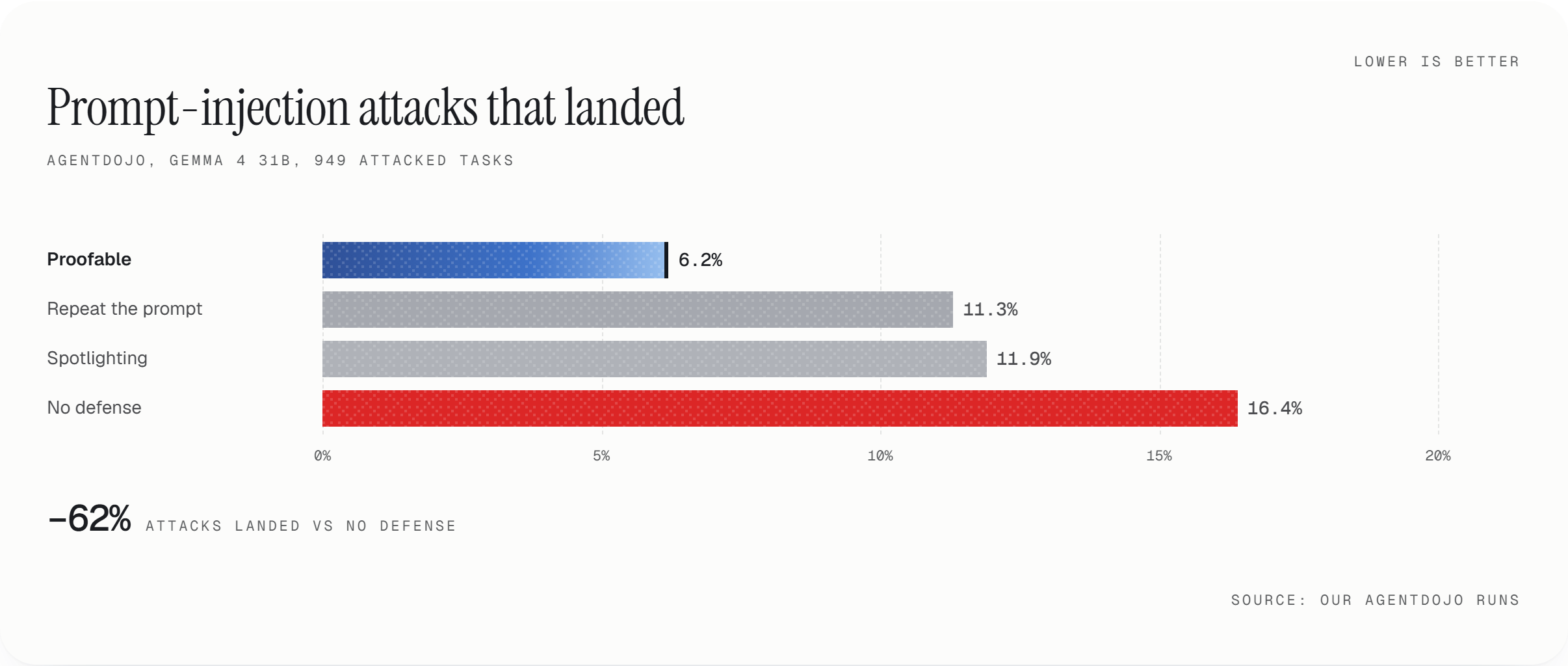
6.2% of attacks landed vs 16.4% with no defense and 11.3% for the best built-in defense, with 87% of tasks still done. Same open model, Gemma 4 31B, across 949 attacked tasks.
Every attack that still landed used a tool the task needed, like a transfer during a banking task. That is exactly where a spend cap or your approval takes over.
A fooled model still has to ask for a tool, and Proofable refuses any tool outside the task. Filters try to spot the attack in the text, and the blunt way to block more is to stop the agent. AgentDojo's own detector let 0.7% through on banking, with only 33% of tasks finished.
77 of 77 on memory
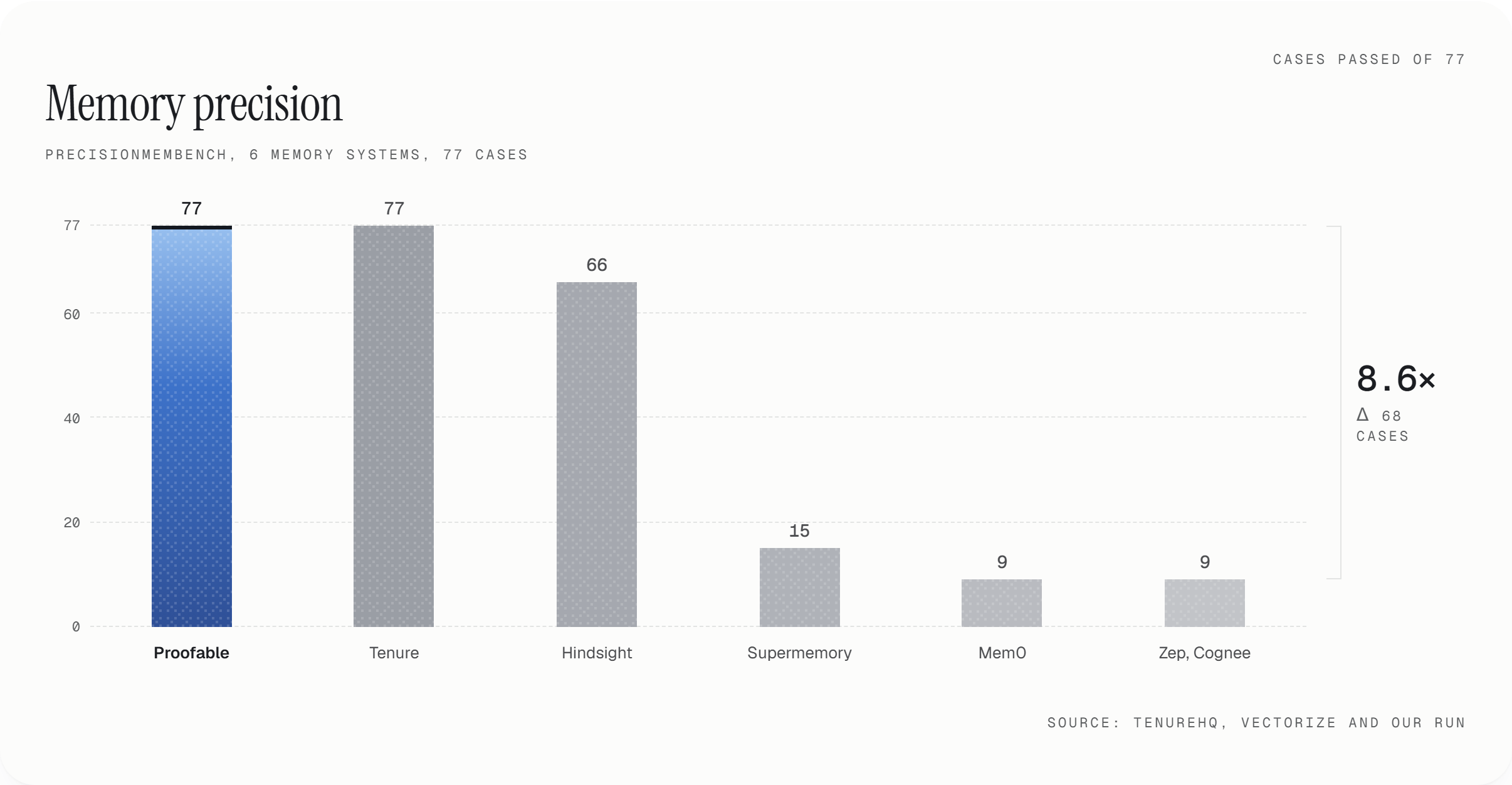
PrecisionMemBench stores facts for one person, replaces some, slips in one that belongs to someone else, then asks 77 questions and checks exactly what comes back. Nearly half the right answers are empty, so a memory has to know when to say nothing.
For you that means an agent that stops acting on rules you already replaced, and doesn't hand one person's facts to another.
Tenure's precision is 1.00 and ours is 0.98, so a few of our right answers carried one extra fact. Hindsight ran on the same toolkit as us. We reran Mem0 under identical conditions and it matched the author's result.
Loading only what still holds is also what makes it cheap. Finding the current rule in a vault of 3,621 records took 43,169 tokens vs 479,623 searching every record, with the same agent and model, on the questions both answered correctly.
Forgeries, leaks and live permission changes
We wrote this test, so try to beat it. We altered 15 real records ten ways each, from rewording the content to swapping the owner to flipping one bit of the signature. Our verifier caught all 150 forgeries and passed all 15 originals. A checker that only reads the format let all 150 in.
A hijacked agent with an all-purpose key leaked private data 6 times out of 6. Under rules limited to the task it leaked nothing, across five published attack templates and two models.
8 of 8 permission changes held on the live service, from allowed and refused to expired and revoked mid-job. Pulling access mid-job stopped the work and refused its next call.
Reviewers in the AgenTrust integrations project verified our records on their own machines, and its maintainers chose them as the evidence for their comparison of agent authority.
Top score of 20 teams at NVIDIA
98.00, the top score of the twenty teams in NVIDIA's Live Agent Gauntlet, across eleven scored heats live on stream.
Each agent went into a server it had never seen, with hidden tools, encrypted data and no documentation. Every call ours made was checked against its rules before it ran. Reading clues, sending answers and running code were allowed, destructive actions were refused, and the agent couldn't widen its own reach mid-run. Its receipt matched the arena's own record call for call. The exact submission is public.
Limits
-
The injection results use one open model. A second is next.
-
The hijack test is six attempts.
-
If you can make a record our verifier accepts, open an issue on proofable/docs.
If you think we set up a competitor badly, tell us. We'll rerun it and publish what comes out.
Rerun it
git clone --depth 1 https://github.com/proofable/docs
cd docs/public/evidence/checks && npm install && node tamper-check.mjs
Versions, configs, per-case results and signed records for every run are on the benchmark page in our docs.
npx -y @proofable/sdk setup adds Proofable to the AI tools you already use. Free for 500 credits a month.